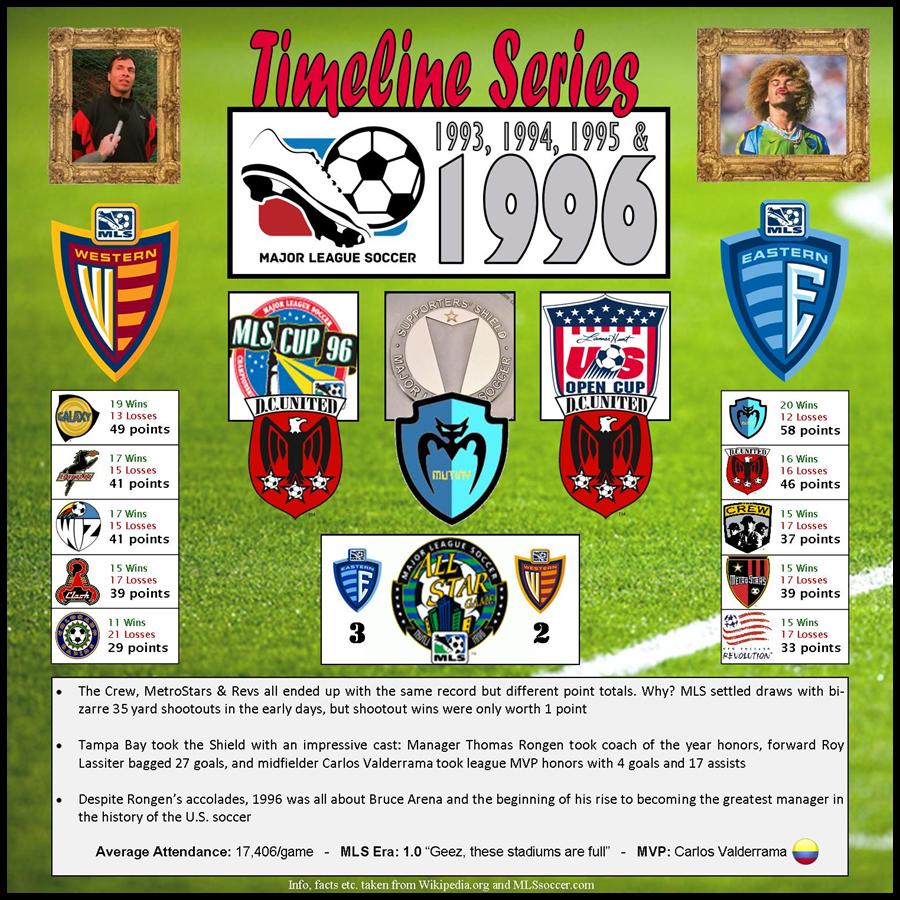
The first tile in my MLS Timelines Series lies below, click on it to enhance the picture. I am also including write ups for each season, so give those a try if you’re hungry for more after looking over the tiles.
 MLS: The Beginning
FIFA awarded the 1994 World Cup to the U.S.A. on the condition that the United States Soccer Federation (USSF) establish a top tier professional soccer league. Major League Soccer came to be in 1993 and was formally founded as an LLC in 1995. In February of ’96, MLS held its inaugural Player Draft and the Columbus Crew made USMNT legend Brian McBride the first player ever selected. The league officially began play on April 4th, 1996 as the then San Jose Clash rode an Eric Wynalda goal (see the highlight below) to a 1-0 win over DC United in San Jose. The 1996 regular season would see the rise of USMNT legends like Brad Friedel, GK for Columbus Crew, and fan favorite Cobi Jones, a forward for LA Galaxy. The then Dallas Burn also had a pair of standouts in MLS’ inaugural season as forward Jason Kreis bagged 13 goals and 5 assists and GK Mark Dodd stole ‘Keeper of the Year honors. In the end it was the star studded Tampa Bay Mutiny, led by Coach of the Year and awesome dude Thomas Rongen, who would take the first ever Supporters’ Shield. Side note: even though the Shield did not exist in 1996, it was retroactively awarded to previous winners after its creation in 1999. The first ever MLS Cup Final was played on a nasty weather day in Foxboro in front of more than 30,000 fans. Bruce Arena’s DC United defeated the LA Galaxy 3-2 in a matchup that foreshadowed the two clubs’ future MLS success. Despite leading the league with 27 goals (a record that would go unmatched until 2012 and still hasn’t been topped), Tampa Bay’s Roy Lassiter missed out on the MVP trophy. Instead it was his teammate, Colombian International Carlos Valderrama, who took MVP honors after netting 4 goals and 17 assists on the year all while sporting a world class afro. Most of all, the ’96 season marks the beginning of the meteoric rise of Bruce Arena, who crushed at DC United for three years before a memorable eight year stint at the helm of the Men’s National Team. Simply put, he is the greatest American manager ever.
A Highlight from the Inaugural Season
The first goal in MLS history, mentioned above, was also voted as the season’s goal of the year. It was a deserving winner, as Eric Wynalda breaks some ankles before blasting it into the top corner.
Shootouts, MLS Style
It is noted in the tile but deserves an explanation here because it is bizarre. For the first four seasons of MLS play, matches that ended in a tie were decided with a shootout. Shootout winners were only awarded one point rather than three. The weird part was the shootout itself, where MLS elected to go with a 35-yard starting spot and a run up rather than the traditional spot kick from 12 yards out. Have a look at this old, pixel filled video and see how weird it was. The whacky shootout ended in 2000 when the league implemented a standard W/L/D system.
THE BOTTOM LINE
Attendance
Notice with each season’s overall attendance figures I’ll be including a red or a green number to reflect the negative or positive change in attendance for the the season.
MLS Eras Defined
You may have noticed that each season is labeled with an MLS era (center of the bottom row). MLS Writer Matthew Doyle breaks the history of MLS into three different eras that I am incorporating into my timeline. I have offered a brief description of each era if you don’t get a chance to read his article.
- MLS 1.0 1996 – 2005 – Doyle further breaks down this era into four sub-parts (notice the quote next to the MLS Era tag below)
- MLS 2.0 2006 – 2013 – The rise of supporters clubs, MLS style
- MLS 3.0 2014 – ? – US Internationals signing DP contracts to play Stateside
MVP Winner
Each season’s MVP will be acknowledged in the bottom right of each tile:
Full Name(MLS club)/Nationality
As always, feel free to leave a comment, make a suggestion, or correct a possible mistake. Anything to improve the project.
Thanks, Internet
As I move on from tile #1, I’d like to thank Wikipedia.org and MLSsoccer.com for being amazing resources (those two sites alone are basically where this entire project comes from). My MLS Timeline Series is more of a collection and presentation of information than it is a show of historical, intimate knowledge of the league.
**Brilliant, Relevant Read**
The above link is to a great article that provides a more in depth look at the beginning of Major League soccer.
 Soccer Therapy